Nature-based Classical Education in Brooklyn
A new K–5 microschool cultivating wisdom, virtue, and wonder through classical learning and the natural world.
Inquire Now Learn More
The Three Pillars
True education forms the whole person. Our curriculum integrates physical vigor, intellectual depth, and spiritual formation.
Daily outdoor exploration in Prospect Park. Nature study, physical fitness, and learning to move through the world with confidence and capability.
Engagement with great works and ideas through Socratic seminars. Classical languages, history, literature, and the liberal arts tradition.
Character education rooted in timeless wisdom and the pursuit of the good, true, and beautiful.
Our Philosophy
Diomedes, hero of the Iliad, embodied the classical ideal: brave in battle, wise in counsel, and faithful to the gods. He stood among the greatest of the Greeks not through pride, but through virtue earned in action.
Our school takes his name as an aspiration. We seek to form children who are strong, thoughtful, and good—prepared to meet the world with courage and compassion.
"Raising his spear, the lord of the war cry drove it home, planting it deep down in the earth that feeds us all."— Homer, The Iliad, Book 6
Curriculum
Foundational literacy follows the science of reading: systematic phonics instruction, phonemic awareness, and structured progression from decoding to fluency. We don't wait for reading to emerge naturally—we teach it explicitly because alphabetic writing is a code that must be cracked. Alongside this structured foundation, students encounter rich literature through daily read-alouds and narration (retelling in their own words), building vocabulary, comprehension, and love of story. Writing develops from copywork and dictation toward original composition. Grammar is taught directly but applied in meaningful contexts. The goal is functional literacy as quickly as possible so students can read to learn rather than learn to read.
Mathematics combines structured mastery of arithmetic with the problem-solving culture of Russian Math Circles. Procedural fluency matters—students learn standard algorithms, build automaticity with facts, and progress systematically through operations, fractions, and pre-algebraic thinking. But alongside this, weekly math circles present students with genuinely difficult problems they haven't been taught to solve. The teacher asks questions rather than demonstrating solutions. Students struggle productively, debate approaches, encounter dead ends, and discover that mathematics is something you do rather than something you receive. The two modes reinforce each other: procedural fluency frees working memory for problem-solving; problem-solving reveals why procedures matter.
Music education integrates Orff Schulwerk's exploratory, improvisatory approach with Schafer's deep listening practice, scaffolding toward musical literacy. Students begin by making sound—body percussion, voice, simple instruments—improvising within constraints (pentatonic scales, call-and-response structures) before encountering notation. Parallel to this, ear cleaning exercises train attention: cataloging environmental sounds, describing timbres, taking soundwalks, learning to hear the acoustic world as a composition. Notation and music theory emerge as useful tools when students need them to remember, communicate, or analyze. By upper elementary, students read music, sing in parts, and have experience both as performers and composers—but more importantly, they hear the world differently.
Following Josef and Anni Albers, art instruction treats perception as a skill to develop and materials as things to investigate. Students explore color interaction (how context changes what we see), discovering through direct experiment that the same hue appears different against different backgrounds. They work with physical materials—paper, fiber, clay, found objects—learning what each can do through manipulation before being taught technique. Constraints drive creativity: limited palettes, single-material projects, observation drawing where you look at the object rather than the paper. Process and experimentation are documented alongside finished work. Technical skills (color mixing, weaving, construction) accumulate through projects rather than isolated exercises. The goal is trained attention and material thinking—foundations that serve whether a student becomes an artist or simply someone who sees.
Nature study is science grounded in primary observation. Students spend substantial time outdoors, learning to look carefully at what is actually present: this particular tree, this bird, this weather pattern, this rock formation. They keep nature journals combining drawing, measurement, and written observation—recording what they see before learning what it's called. Identification and classification follow from genuine curiosity: what is this thing I've been watching? Seasonal rhythms structure the curriculum; students track phenology (first frost, bird migrations, bloom times) across years, building intuition for natural patterns. Formal concepts—life cycles, ecosystems, adaptation, geology—emerge from accumulated observation rather than preceding it. Dissection, microscopy, and simple experiments introduce scientific method, but the foundation is disciplined attention to the living world.
History is taught chronologically and narratively—students build a coherent timeline from ancient civilizations forward rather than bouncing thematically between eras. Primary sources, living books, and biographical narrative make the past vivid and particular rather than abstract. Memory work (key dates, maps, significant figures) provides scaffolding for understanding. Geography begins locally: students map their neighborhood, observe landforms, understand their watershed, and learn to orient themselves before encountering world geography. Physical and human geography interweave—why cities form where they do, how terrain shapes culture, how climate constrains possibility. The experiential element is cartographic: students make maps, read maps, and learn to see landscape as legible. The classical element is substantive knowledge of what happened, where, and why it matters.
Students learn to make useful things with their hands: sewing, woodworking, cooking, textile arts. This follows the Bauhaus conviction that head and hand should develop together, and the classical recognition that practical competence is foundational to education. Projects progress from simple to complex across years—a first-grader learns to thread a needle, a fifth-grader constructs a simple piece of furniture. Emphasis falls on craft: measuring accurately, following sequences, attending to quality, finishing what you start. Students encounter real constraints (material limits, structural requirements, time) and learn to work within them. The discipline required to make something well transfers to other domains, and students graduate with genuine practical capabilities alongside academic skills.
Physical education develops both bodily competence and love of movement. The classical element is systematic: students develop fundamental movement skills (running, jumping, throwing, climbing, swimming, tumbling), build strength and endurance progressively, and learn proper form. The experiential element is play: unstructured outdoor time, games with emergent rules, exploration of what bodies can do. Both matter. We aim for students who can run a mile, swim confidently, do basic gymnastics, and throw accurately—measurable physical competencies. But also students who associate movement with joy rather than drudgery, who go outside by choice, who inhabit their bodies comfortably. Team games develop cooperation and rule-following; individual challenges build persistence. Movement is daily, not occasional.
Our Home
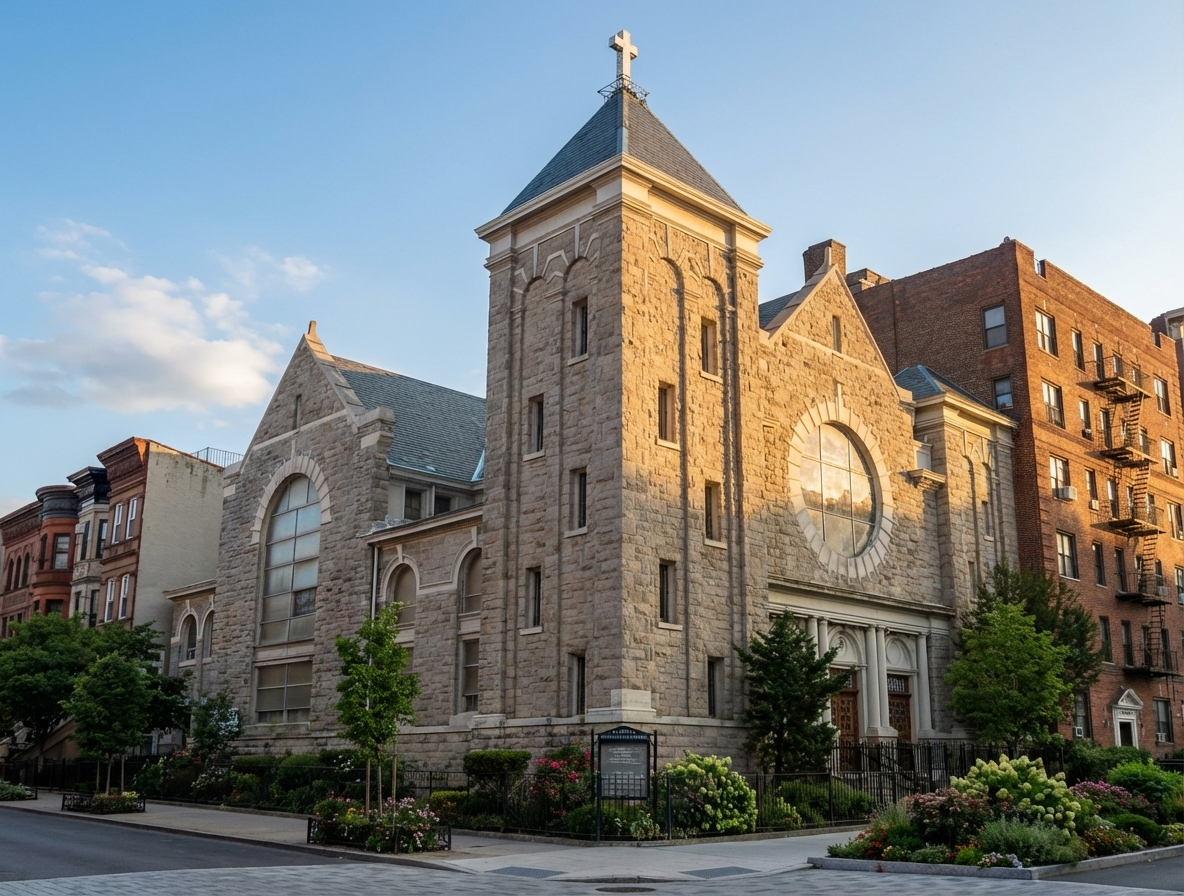
The Diomedes School is housed within a beautiful Brooklyn church, providing a dignified and inspiring setting for classical education.
Steps from Prospect Park — Our nature-based curriculum takes full advantage of 585 acres of meadows, forests, and waterways.
Historic Architecture — Learning happens in spaces that reflect the permanence and beauty we seek to cultivate.
Small by Design — Our microschool model allows for deep relationships and individualized attention.
Join Us
We invite interested families to reach out.